

Catering for Film Productions: A Toronto How-To Guide
Table of Contents
- How to Plan Catering for Film Productions in Toronto
- Step 1: Confirm Your Production Size and Shoot Schedule
- Step 2: Set a Per-Head Catering Budget
- Craft Services vs Catering: What Each One Covers
- Film Production Meal Break Requirements on Set
- Craft Services Checklist for 8 Hour Days
- Dietary Restrictions, Food Safety, and Sustainability on Set
- How to Hire a Film Production Caterer in the GTA
- Frequently Asked Questions
Last Updated: September 17, 2026
How to Plan Catering for Film Productions in Toronto
Film production catering for Toronto crews is a logistics problem before it is a food problem. Get the headcount, shoot hours, or budget wrong and even excellent food arrives at the wrong moment. This guide from Alijandro's Kitchen covers sizing the order, setting a per-head budget, separating craft services from catering, meeting meal break rules, and hiring a caterer who has worked a set.
Step 1: Confirm Your Production Size and Shoot Schedule
Start with two numbers: how many people eat, and when the day breaks.
- Confirm headcount 48 hours before each shoot day
- Note call time, estimated meal break, and wrap time
- Flag any day with a location move or overtime risk
- Identify who eats on set versus who takes meals to a basecamp
Step 2: Set a Per-Head Catering Budget
Budget by head, per meal, and build in the extras that catch people out. A per-head figure keeps the conversation honest and scales when the unit grows.
Three costs get forgotten most often:
- Second meals. A 14-hour day is two meals, not one. Budget for it from the start.
- Overtime and turnaround. Late changes and extended days carry staffing costs.
- Equipment and cleanup. Chafing dishes, urns, tables, and waste removal may be billed separately.
Craft Services vs Catering: What Each One Covers
Craft services and catering are two separate functions, and conflating them is the most common planning error on set. Catering provides scheduled hot meals, typically lunch and a second meal on long days. Craft services covers the continuous snack and beverage table between takes.
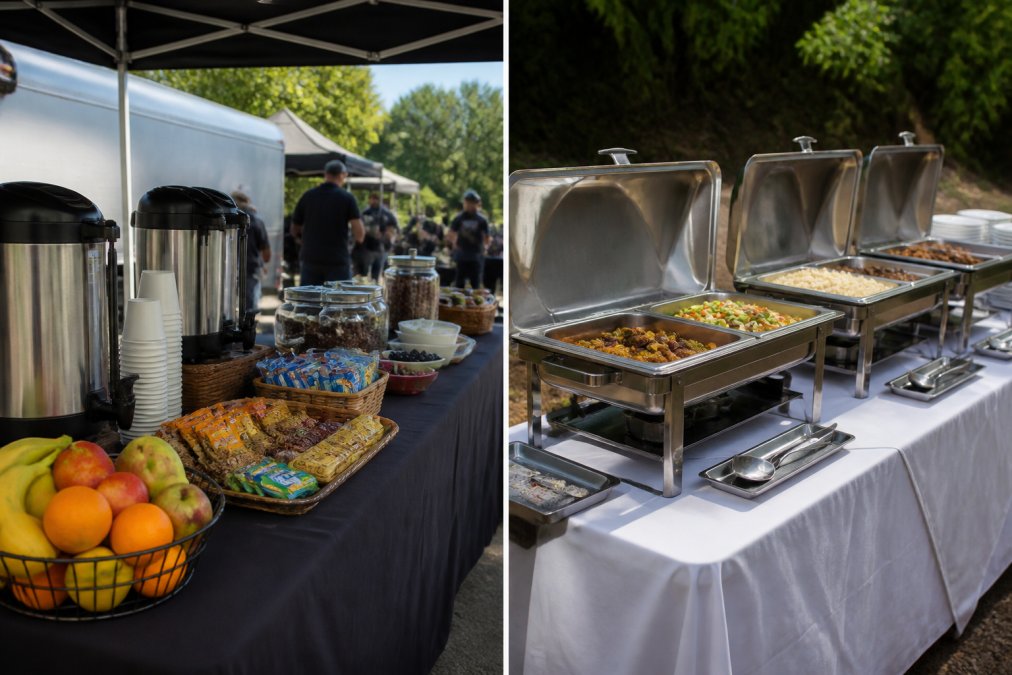
| Feature | Craft Services | Catering |
|---|---|---|
| Timing | Continuous, all day | Scheduled meal breaks |
| Format | Self-serve snack table | Hot meal, staffed |
| Typical items | Coffee, fruit, bars, water | Protein, starch, vegetables, dessert |
| Space needed | Small table, nearby | Dedicated area, power, waste |
| Who manages | Often production or PA | Professional caterer |
Film Production Meal Break Requirements on Set
Meal break requirements on set are not a courtesy, they are an entitlement under employment standards, and on union shoots they carry financial penalties when missed. A coordinator who understands both layers can plan the day so the break is called on time and the penalty clock never starts.
The statutory layer
In Ontario, the Employment Standards Act, 2000 sets the floor. An employee who works five or more consecutive hours is entitled to an eating period of at least 30 minutes, which can be split by agreement into two periods of at least 15 minutes each within the five-hour span. The break can be unpaid if the employee is free from work duties, or paid if not.
The union layer
Most scripted productions in the region operate under agreements with unions such as ACTRA (performers), IATSE (crew), the Directors Guild of Canada, and the Teamsters. These typically require a meal break within a set window, commonly five to six hours from general call, and impose a meal penalty when the break is late, usually paid per person, per half hour, across the whole unit.
What this means for catering
- The meal break is a fixed point the schedule is built around, not a gap filled when the shot is done.
- Hot food must be ready the moment the AD calls the break; the penalty clock starts when the window closes, not when food arrives.
- A second meal on extended days is cheaper than a meal penalty. Budget for it from the start.
- Document break and meal service times for production reporting; penalty disputes are settled on the paperwork.
Craft Services Checklist for 8 Hour Days
A craft services checklist for 8 hour days should cover setup, restock, and breakdown, with enough variety to keep people eating without slowing them down. Print it, assign an owner, and tick it off.
- Coffee urns and hot water set up before call
- Tea, hot chocolate, and decaf options
- Chilled water and electrolyte drinks in coolers
- Fresh fruit, washed and ready to eat
- Granola bars, nuts, and trail mix
- Gluten-free and nut-free alternatives, clearly labeled
- Savory snacks for the mid-afternoon dip
- Paper cups, lids, stirrers, and napkins stocked
- Bins for waste and recycling beside the table
- Restock check at the halfway point of the day
Sample Menu Ideas for Different Production Types
Menu structure should match the production. A commercial shoot and a scripted series have different rhythms.
Dietary Restrictions, Food Safety, and Sustainability on Set
Dietary planning, food safety, and waste reduction separate a professional caterer from a food truck.
- Collect dietary requirements at booking and re-confirm 48 hours out
- Require labeled, separate options for allergens
- Confirm hot and cold holding practices and temperature logs
- Specify reusable or compostable service ware in the contract
- Agree on waste separation and surplus food handling
How to Hire a Film Production Caterer in the GTA
Hiring a film production caterer in the GTA comes down to set experience, coverage, and the paperwork that protects the production if something goes wrong. Plenty of caterers cook well. Fewer can pass a production's vendor qualification, and that is the bar that matters.
The five documents to request before you book
Most production managers run a standard vendor check. Ask for these up front, not after signing:
- Food Handler Certification. In Ontario, at least one person on site who handles or supervises food must hold a valid Food Handler Certificate issued under the Food Safety Protocol (Food handler training and certification). Ask who holds it and confirm it is current.
- Commercial general liability insurance. Productions typically require a certificate of insurance naming the production company as additional insured, with limits set by the production's own policy. Ask for the COI before the first shoot day.
- WSIB coverage. A caterer with employees must be in good standing with the Workplace Safety and Insurance Board. Ask for a clearance certificate, it is free to obtain and it confirms the caterer is not passing their payroll liability onto your production.
- HST registration. A caterer billing more than $30,000 per year must be HST-registered. An unregistered vendor cannot issue a valid tax invoice, which creates a problem at production accounting.
- Business licence and, if applicable, a Toronto Food Premises licence. Confirm the caterer is licensed to operate a food premises if they are preparing food in a commercial kitchen.
The reference call that actually tells you something
Asking for references is standard; asking the right questions separates real vetting from a formality. Call two or three production coordinators who have used the caterer and ask:
- Did the food arrive on time on every shoot day, including the days the schedule moved?
- How did they handle a headcount change the morning of the shoot?
- What happened when a crew member had a severe allergy?
- Did the final invoice match the quote, or were there surprise line items?
- Would you book them again on a larger unit?
Coverage and logistics across the GTA and Ontario
Confirm service areas in writing. A caterer covering the core studio zones may still charge travel and setup for outer GTA or Ontario locations. Ask about:
- Travel radius and how travel time is billed
- Setup and breakdown time on site, and whether it is included in the per-head rate
- Equipment brought on site (chafing dishes, urns, tables, tents, generators) and what the production is expected to provide
- Power and water requirements at the location
- Waste removal, who owns it, and whether it is billed separately
Scalability and menu flexibility
Ask how the caterer handles a unit that grows by 30 percent between the call sheet and the shoot day. One who flexes headcount without a new quote beats one who charges a change fee every time the AD adds background performers.
Frequently Asked Questions
What is the difference between craft services and catering on a film set?
Craft services covers the ongoing snacks, coffee, and drinks available all day, while catering handles the scheduled hot meals, usually lunch and sometimes a second meal on long shoot days. Craft services keeps cast and crew fueled between takes, and catering delivers full meals during set meal breaks. Both matter for morale and energy on set.
How do you calculate catering costs for a film production?
Costs depend on headcount, number of meal services, menu complexity, and dietary requirements. Most productions budget per person per meal. Request quotes from caterers based on your exact crew size and shoot schedule. Alijandro's Kitchen can provide a custom quote once you share your production details and dietary needs.
What dietary requirements should be considered for film crew catering?
Plan for gluten-free, nut-free, vegetarian, vegan, halal, and dairy-free options at minimum. Ask crew about allergies and intolerances during pre-production. Cross-contamination matters as much as the menu itself, so choose a caterer who separates preparation areas and labels every dish clearly.
How do you manage food safety standards for on-set catering?
Caterers must follow local health regulations for food handling, storage temperatures, and holding times. Hot food stays above 60°C and cold food below 4°C. Ask your caterer about their food safety certifications and how they handle leftovers. On-location setups need proper equipment to maintain safe temperatures throughout the meal service.
Catering a shoot well is a coordination challenge, and the productions that get it right treat food as part of the schedule, not an afterthought. Alijandro's Kitchen offers professional catering, meal prep, and kitchen services built around your shoot day, with flexible menus, dietary accommodations, and full-service coordination. Get started with Alijandro's Kitchen and give your cast and crew meals they can count on.